Introduction
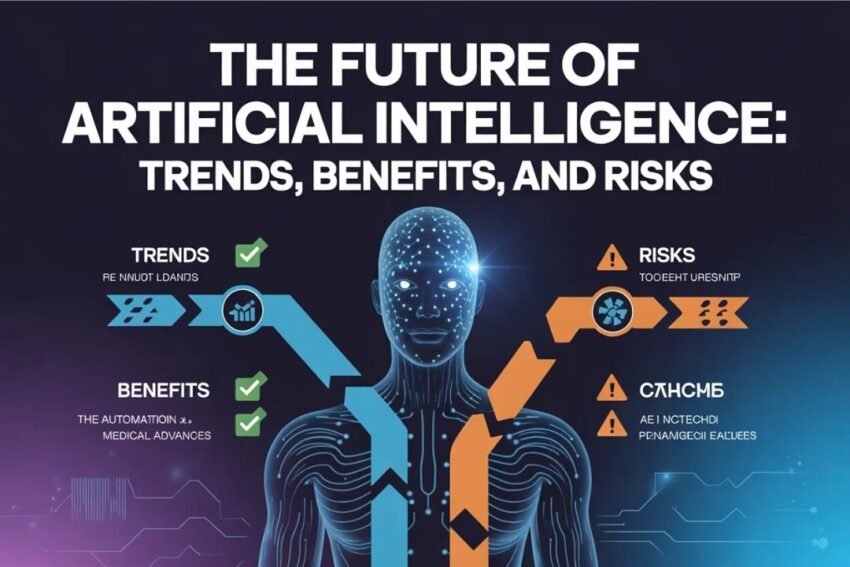
Artificial Intelligence (AI) is evolving at an unprecedented pace and is expected to play a central role in shaping the future of humanity. What once existed only in science fiction is now deeply embedded in our daily lives—from smart assistants and recommendation systems to advanced medical diagnostics and autonomous vehicles.
As AI continues to advance, it brings immense opportunities along with serious challenges. Understanding the future of artificial intelligence, including its key trends, benefits, and risks, is essential for individuals, businesses, and governments alike.
What Does the Future of AI Look Like?
The future of AI is not about machines replacing humans entirely; instead, it is about collaboration between humans and intelligent systems. AI will become more autonomous, more personalized, and more integrated into everyday life.
Future AI systems will:
- Learn faster with less data
- Make more accurate decisions
- Interact with humans more naturally
- Operate responsibly under ethical guidelines
Key Trends Shaping the Future of Artificial Intelligence
1. Generative AI Expansion
Generative AI tools can create text, images, videos, music, and even code.
Future impact:
- Automated content creation
- AI-assisted design and development
- Faster innovation in creative industries
Generative AI will become a standard tool across education, marketing, software, and entertainment.
2. AI in Healthcare and Biotechnology
AI will revolutionize healthcare by:
- Detecting diseases earlier
- Personalizing treatment plans
- Accelerating drug discovery
- Assisting surgeries with precision
In the future, AI-powered healthcare systems will save lives and reduce medical costs worldwide.
3. Autonomous Systems and Robotics
AI-driven robots and autonomous systems will become more common in:
- Manufacturing
- Logistics
- Agriculture
- Transportation
Self-driving vehicles, delivery drones, and smart robots will transform how goods and services are produced and delivered.
4. Personalized AI Assistants
Future AI assistants will:
- Understand emotions and context
- Adapt to individual user behavior
- Act as personal advisors
These assistants will help manage schedules, finances, health, and learning more intelligently than ever before.
5. Ethical and Regulated AI
As AI grows more powerful, governments and organizations will focus on:
- Transparency
- Fairness
- Accountability
- Data protection
The future will see stronger AI regulations to ensure responsible and ethical use of technology.
Benefits of Artificial Intelligence in the Future
AI offers numerous advantages that will shape society positively.
1. Increased Productivity and Efficiency
AI will automate repetitive tasks, allowing humans to focus on:
- Creativity
- Strategic thinking
- Problem-solving
This will significantly boost productivity across industries.
2. Economic Growth and Innovation
AI will:
- Create new job roles
- Enable startups to scale faster
- Drive global economic growth
Countries investing in AI will become leaders in innovation.
3. Improved Quality of Life
AI will enhance daily life by:
- Improving healthcare outcomes
- Making cities smarter
- Reducing traffic congestion
- Enhancing accessibility for people with disabilities
4. Better Decision-Making
AI systems analyze vast amounts of data to:
- Predict trends
- Reduce risks
- Support smarter decisions
This will benefit businesses, governments, and individuals alike.
Risks and Challenges of Future AI
Despite its benefits, AI also poses serious risks.
1. Job Displacement
Automation may replace certain jobs, especially:
- Repetitive manual work
- Data processing roles
This creates the need for reskilling and workforce adaptation.
2. Bias and Discrimination
AI systems trained on biased data can:
- Make unfair decisions
- Reinforce social inequalities
Ensuring fairness in AI will remain a major challenge.
3. Privacy and Data Security
AI depends heavily on data, raising concerns about:
- Surveillance
- Data misuse
- Cybersecurity threats
Strong data protection policies will be critical.
4. Misinformation and Deepfakes
AI-generated content can be misused to:
- Spread fake news
- Create deepfake videos
- Manipulate public opinion
This poses risks to trust, democracy, and social stability.
5. Loss of Human Control
Highly autonomous AI systems may:
- Make decisions humans do not fully understand
- Act unpredictably
Maintaining human oversight will be essential.
Balancing Innovation and Responsibility
The future of AI depends on finding the right balance between:
- Technological advancement
- Ethical responsibility
This includes:
- Transparent AI models
- Human-in-the-loop systems
- Global cooperation on AI standards
AI and the Future Workforce
AI will change how people work, not eliminate work entirely.
Future workforce trends:
- Demand for AI and data skills
- Growth in creative and strategic roles
- Lifelong learning becoming essential
Education systems will need to adapt to prepare people for an AI-driven world.
Will AI Become Smarter Than Humans?
The idea of AI surpassing human intelligence—often called Super AI—remains theoretical.
While AI may outperform humans in specific tasks, true human-level intelligence with emotions, consciousness, and moral reasoning is still far from reality.
How Can We Prepare for the AI Future?
Individuals and organizations can prepare by:
- Learning AI fundamentals
- Developing digital skills
- Promoting ethical AI use
- Staying informed about AI regulations
Preparation ensures that AI becomes a tool for empowerment rather than disruption.
Conclusion
The future of artificial intelligence is both exciting and challenging. AI has the potential to revolutionize healthcare, education, business, and daily life while driving economic growth and innovation. However, it also brings risks related to privacy, bias, employment, and security.
By developing AI responsibly, investing in education, and enforcing ethical standards, society can ensure that artificial intelligence benefits humanity as a whole.